
South Carolina: The Battleground State
Thanks to jim Heritage for finding this GEM and posting on the Godfrey Dreher website: https://gdc.scssar.org/the-battleground-state-2/.
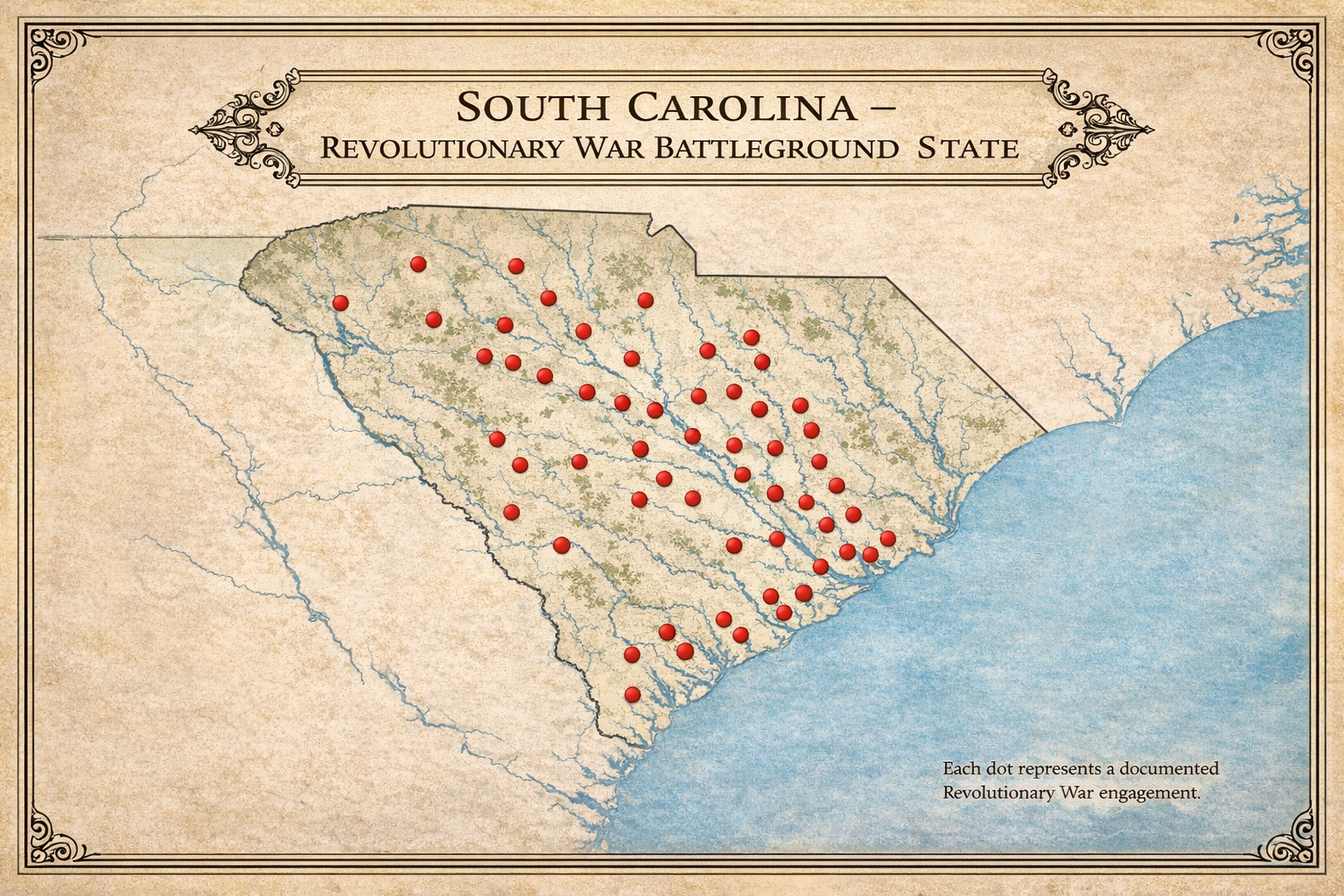
South Carolina—more than any other colony—became the crucible of the Revolutionary War. From the first shots in the backcountry to the final British evacuation of Charleston, its soil bore the weight of relentless conflict. Here, neighbor fought neighbor in a brutal civil war layered atop the struggle for independence. Battles, skirmishes, and sieges scarred towns, plantations, rivers, and crossroads, leaving a legacy of sacrifice and resilience. These engagements, large and small, reveal how South Carolina earned its place as the Revolutionary War’s true battleground state—where the tide turned, and where American independence was ultimately secured.
First Siege of Ninety-Six (Nov 19–21, 1775)
Patriot militia besieged Loyalist forces at Ninety-Six in one of the earliest southern engagements of the Revolutionary War. Lacking artillery, the Patriots failed to capture the stronghold. The clash revealed deep divisions between Loyalists and Whigs in South Carolina’s backcountry and foreshadowed the brutal civil war that would follow.
Battle of Great Cane Break (Dec 22, 1775)
Patriot forces pursued and defeated Loyalist militia near Ninety-Six following earlier tensions in the region. The engagement resulted in captured prisoners and weakened Loyalist resistance. This early victory helped establish Patriot momentum in the South Carolina backcountry during the opening months of the Revolutionary War and strengthened Whig confidence.
Battle of Sullivan’s Island (June 28, 1776)
American forces successfully defended Charleston Harbor by repelling a British naval assault on Sullivan’s Island. Fort Moultrie’s palmetto-log walls absorbed cannon fire, enabling a decisive Patriot victory. The battle boosted morale, preserved Charleston temporarily, and demonstrated that American forces could withstand Britain’s powerful navy in open combat.
Battle of Lindley’s Fort (July 15, 1776)
Cherokee warriors attacked a frontier settlement fort defended by Patriot settlers. The assault reflected the broader alliance between the British and Cherokee forces seeking to curb colonial expansion. Though the settlers resisted, the attack intensified frontier violence and underscored the war’s impact beyond traditional battlefields in the southern colonies.
Battle of Port Royal Island (Feb 3, 1779)
British forces defeated Patriot militia on Port Royal Island, securing an important coastal foothold. This victory supported Britain’s southern strategy by enabling further operations along the South Carolina coast. The engagement demonstrated British naval and land coordination and highlighted the vulnerability of lightly organized Patriot militia against professional troops.
Battle of Stono Ferry (June 20, 1779)
Patriot forces launched an attack against entrenched British troops near Charleston at Stono Ferry. Despite initial gains, the Americans failed to dislodge the British. The battle ended in a tactical British victory, preserving their defensive position and delaying Patriot efforts to reclaim control of the South Carolina lowcountry.
Siege of Charleston (Mar 29–May 12, 1780)
British forces under General Clinton besieged Charleston, forcing the surrender of a major American army. This devastating defeat resulted in thousands of Patriot troops captured and marked a turning point in the southern campaign. British control of South Carolina was firmly established, though resistance would soon reemerge in the backcountry.
Battle of Monck’s Corner (Apr 14, 1780)
British cavalry surprised and routed American forces at Monck’s Corner, capturing vital supplies, artillery, and horses. This victory crippled Patriot mobility and communication during the Charleston campaign. The loss contributed significantly to the collapse of organized American resistance in the region and strengthened British dominance in South Carolina.
Battle of Lenud’s Ferry (May 6, 1780)
British troops attacked American forces attempting to withdraw from the Charleston area at Lenud’s Ferry. The Patriots were defeated, suffering casualties and losing supplies. This engagement further weakened American resistance during the critical days before Charleston’s fall, aiding British efforts to consolidate control across South Carolina.
Battle of Waxhaws (May 29, 1780)
British cavalry under Banastre Tarleton overwhelmed a retreating American force at Waxhaws. The engagement became infamous for alleged brutality against surrendering troops, fueling Patriot outrage. The phrase “Tarleton’s Quarter” spread rapidly, galvanizing resistance and strengthening recruitment for the Patriot cause throughout the southern colonies.
Battle of Huck’s Defeat (July 12, 1780)
Patriot militia led by William Bratton and others ambushed Loyalist forces under Captain Christian Huck. The decisive Patriot victory eliminated a feared Loyalist leader and boosted morale. It demonstrated the growing effectiveness of partisan warfare in the South Carolina backcountry and encouraged further resistance against British authority.
Battle of Cedar Springs (July 12, 1780)
Patriot militia engaged Loyalist forces near Spartanburg in a lesser-known but significant skirmish. The encounter reflected increasing resistance to British authority in the backcountry. Though limited in scale, the action contributed to mounting pressure on Loyalist units and illustrated the intensifying civil conflict within South Carolina.
Battle of Hanging Rock (Aug 6, 1780)
Patriot militia attacked a British outpost at Hanging Rock, achieving initial success but ultimately failing to hold the position. The battle demonstrated the courage and persistence of irregular forces while revealing challenges in sustaining victories against disciplined British troops during the southern campaign.
Battle of Camden (Aug 16, 1780)
British forces under Cornwallis decisively defeated American troops led by General Horatio Gates. The rout shattered Patriot forces in the South and exposed weaknesses in leadership and militia reliability. Camden marked a low point for the American cause but set the stage for later reforms and renewed resistance.
Battle of Fishing Creek (Aug 18, 1780)
British forces surprised Patriot militia encamped near Fishing Creek, capturing men, supplies, and wagons. Coming just days after Camden, the defeat compounded American losses. The engagement underscored the vulnerability of militia forces and further destabilized Patriot operations during a critical phase of the southern campaign.
Battle of Musgrove Mill (Aug 19, 1780)
Patriot militia executed a successful ambush against Loyalist troops at Musgrove Mill. Despite learning of the Camden defeat beforehand, they pressed forward and achieved victory. The engagement boosted morale and proved that disciplined militia tactics could defeat Loyalist and British-aligned forces even during difficult times.
Battle of Black Mingo (Sept 29, 1780)
Patriot militia clashed with Loyalist forces near Black Mingo Creek in South Carolina’s lowcountry. The engagement disrupted Loyalist organization and demonstrated the spread of conflict beyond the backcountry. Though small in scale, it contributed to increasing Patriot pressure against British-aligned forces in the region.
Battle of Kings Mountain (Oct 7, 1780)
Frontier Patriot militia surrounded and decisively defeated Loyalist troops at Kings Mountain. The victory eliminated a key Loyalist force and marked a turning point in the southern campaign. It boosted Patriot morale and disrupted British plans to control the Carolinas through Loyalist support.
Battle of Tearcoat Swamp (Oct 25, 1780)
Patriot militia launched a surprise dawn attack on Loyalist troops at Tearcoat Swamp. The successful engagement disrupted Loyalist operations and reinforced Patriot control in the region. It demonstrated the effectiveness of swift, coordinated militia actions against less-prepared Loyalist forces in the South Carolina backcountry.
Battle of Fishdam Ford (Nov 9, 1780)
Patriot forces under Thomas Sumter repelled a British night attack at Fishdam Ford. The defense showed improved discipline and coordination among militia troops. The engagement helped restore confidence following earlier defeats and highlighted the growing resilience of Patriot forces in the southern theater.
Battle of Blackstock’s Farm (Nov 20, 1780)
Patriot forces led by Thomas Sumter defeated British troops but suffered significant casualties, including Sumter’s wounding. Though a tactical victory, the loss of leadership limited its strategic impact. The battle demonstrated both the effectiveness and vulnerability of Patriot militia operations during the southern campaign.
Battle of Cowpens (Jan 17, 1781)
American forces under Daniel Morgan achieved a decisive victory over British troops commanded by Tarleton. Using a clever double-envelopment tactic, the Patriots routed the enemy. Cowpens crippled British offensive capability in the South and marked a turning point leading to eventual American success.
Siege of Fort Watson (Apr 16–23, 1781)
Patriot forces besieged and captured the British outpost at Fort Watson using innovative siege techniques, including a wooden tower. The victory disrupted British supply lines and communications, contributing to the systematic dismantling of British positions across South Carolina during the final phase of the war.
Battle of Hobkirk’s Hill (Apr 25, 1781)
British forces defeated American troops near Camden, but the victory came at significant cost. British losses weakened their hold on the region. Though tactically a British success, the battle contributed to their eventual withdrawal and the restoration of Patriot control in South Carolina.
Siege of Fort Motte (May 8–12, 1781)
Patriot forces captured Fort Motte, a key British supply post, with assistance from local civilians. The fort was set ablaze to force surrender. This victory further disrupted British operations and demonstrated cooperation between Patriot forces and supportive local populations.
Siege of Ninety-Six (May 22–June 18, 1781)
American forces besieged the fortified Loyalist stronghold at Ninety-Six but failed to capture it before British relief approached. Despite the setback, the pressure forced the British to abandon the post soon afterward, weakening their overall position in the South Carolina backcountry.
Capture of HMS Savage (Sept 1781)
American forces captured the British vessel HMS Savage in a naval engagement reflecting growing Patriot maritime capability. Though less prominent than land battles, such actions contributed to disrupting British supply and communication networks during the final stages of the Revolutionary War.
Battle of Eutaw Springs (Sept 8, 1781)
One of the last major battles in the South, Patriot forces engaged the British in a hard-fought contest. Though technically inconclusive, British forces withdrew, effectively ending large-scale combat in South Carolina and signaling the collapse of British control in the region.
Battle of Videau’s Bridge (Jan 3, 1782)
Patriot forces defeated Loyalist troops near Charleston, maintaining pressure on British positions. The engagement reflected ongoing resistance even as the war neared its conclusion and demonstrated continued Patriot determination to reclaim full control of South Carolina.
Battle of Wambaw (Feb 24, 1782)
British forces successfully repelled a Patriot attack near Charleston. Though minor, the engagement illustrated that hostilities persisted late into the war. Skirmishes like Wambaw reflected the unsettled conditions in South Carolina as both sides maneuvered during the final months of conflict.
Battle of the Combahee River (Aug 27, 1782)
British forces conducted a raid along the Combahee River, destroying supplies and freeing enslaved people. Patriot resistance continued despite the war’s nearing end. The raid highlighted ongoing conflict, economic disruption, and the broader human dimensions of the Revolutionary War in the South.
Battle of James Island (Nov 14, 1782)
Late-war skirmishing near Charleston saw British forces maintaining defensive positions while preparing for withdrawal. The engagement reflected lingering tensions and sporadic fighting even as peace negotiations progressed and British evacuation plans were underway.
British Evacuate Charleston (Dec 1782)
British forces evacuated Charleston, ending their occupation of South Carolina. The withdrawal marked the conclusion of major military operations in the state and symbolized the restoration of Patriot control, paving the way for independence and the rebuilding of civil government.
From the first shots in the backcountry to the final British evacuation of Charleston, South Carolina bore the relentless weight of war. Its fields, rivers, and towns witnessed sacrifice, courage, and endurance. These scattered engagements—large and small—collectively turned the tide of the southern campaign. In understanding them, we recognize South Carolina not merely as a battleground, but as a decisive arena where American independence was forged and ultimately secured.

Powered by WordPress